
Comparison
PublicHabits vs. other habit apps: what happens the day after you miss
Every habit app works when you’re motivated. The real test is the day after you miss. If you’ve abandoned a habit tracker before, you know the pattern: the streak breaks, nobody notices, and a week later the app is just another icon on your phone. This guide compares the main ways to build habits on the one question that decides whether a habit sticks: what gets you to show up again tomorrow?
Why habit trackers get abandoned
Habit trackers don’t fail for lack of features. Most of them do the basics well: one-tap check-ins, streaks, a calendar that fills in as you go. They fail because a missed day costs nothing. When you’re the only one who can see your progress, skipping “just today” has no stakes, and quitting the app entirely has none either.
The useful comparison is what each approach puts at stake when you miss, and who notices.
The alternatives at a glance
| Approach | What’s at stake when you miss | Who notices | What it asks of you | Where it breaks down |
|---|---|---|---|---|
| PublicHabits | A blank day on a page people who know you can check | The people you send your link to, with no app or account needed | Share one link (sharing is off until you turn it on) | If you keep your link to yourself. Sharing is what makes it work. |
| Private trackerse.g. Streaks, Loop Habit Tracker, HabitKit | A broken streak only you see | Only you | Nothing beyond logging | The first time motivation dips. You can quietly quit, and nobody notices. |
| Gamified habit trackerse.g. Habitica | Health points, gold, or gear in a game | You, plus anyone you play with in the app | Keep playing the game | When the novelty fades and game penalties stop feeling real |
| Commitment-contract appse.g. stickK, Beeminder | Money you pledged up front | Depends on the app; some let you add a referee or supporters | Agree in advance to pay if you fall short | If you’re not willing to be fined for a bad week, or eventually get tired of putting money on the line |
| Social habit appse.g. HabitShare | Friends in the app might see | Only friends who install the same app | Get friends to join, and keep them checking | When friends won’t install it, or stop opening it |
| Coach or accountability partnere.g. a paid coach, a friend you check in with | Letting down a real person | Your coach or partner | Money, or someone else’s time and schedule | When the payments stop or your partner gets busy |
What actually works
Put the alternatives side by side and a pattern shows up. Each one gets part of the answer right. Commitment contracts and coaches add real stakes. Social apps add real people. Private trackers stay out of your way. None of them puts it all together. Built for someone who has already quit a few trackers, the right approach has four things:
- Real stakes
- A missed day should be noticed by people who know you, not just cost you points in a game.
- No penalty to dread
- The cost of a miss should be that it’s seen, not that you’re fined.
- Nothing for anyone else to do
- The people watching shouldn’t have to install an app, create an account, or schedule a check-in.
- An honest record
- One bad day shouldn’t erase weeks of work, and you shouldn’t be able to quietly lower the bar.
That’s the combination PublicHabits is built around.
How PublicHabits makes the next day matter
People who know you can see whether you showed up
Turn on sharing and send your link to people who know you: your partner, a friend, a parent, a coworker, or your audience on social media. Not random strangers, but people whose opinion of you matters. They can check your habits, streaks, and calendar anytime. Once someone who knows you might look, a skipped day isn’t something only you know about.
Psychologists call this the Hawthorne effect: people behave differently when they know they might be observed. Sharing is off until you turn it on, only people with your link can see your page, and you can turn it off anytime.
Nobody has to join anything
Your page opens in any web browser. Viewers don’t need an account or the app, so you can share with people who would never install a habit tracker, including the people whose opinion you care about most. There’s no feed or follower count to manage, and no check-ins to schedule. People look whenever they want, and you never know when they will.
An honest record you can’t quietly rewrite
Every habit starts with a public commitment in your own words. If you later change it, say from “30 minutes a day” to “20 minutes a day,” PublicHabits adds a dated note your viewers can see. Miss a day and your streak starts over, but every day you’ve already logged stays on your page. Bad habits count days free since your last slip-up. Viewers see an honest record, not a perfect one, and that’s what makes it worth something.
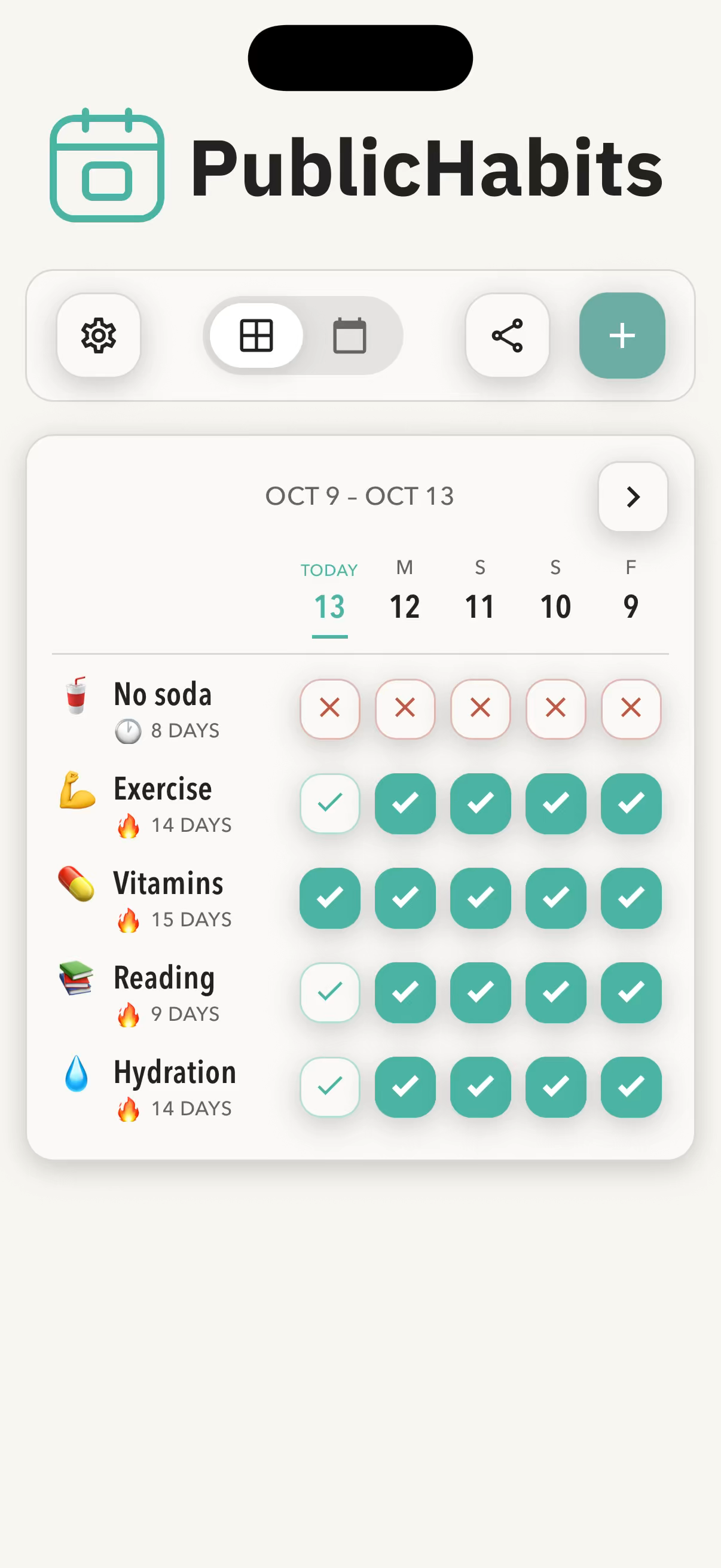
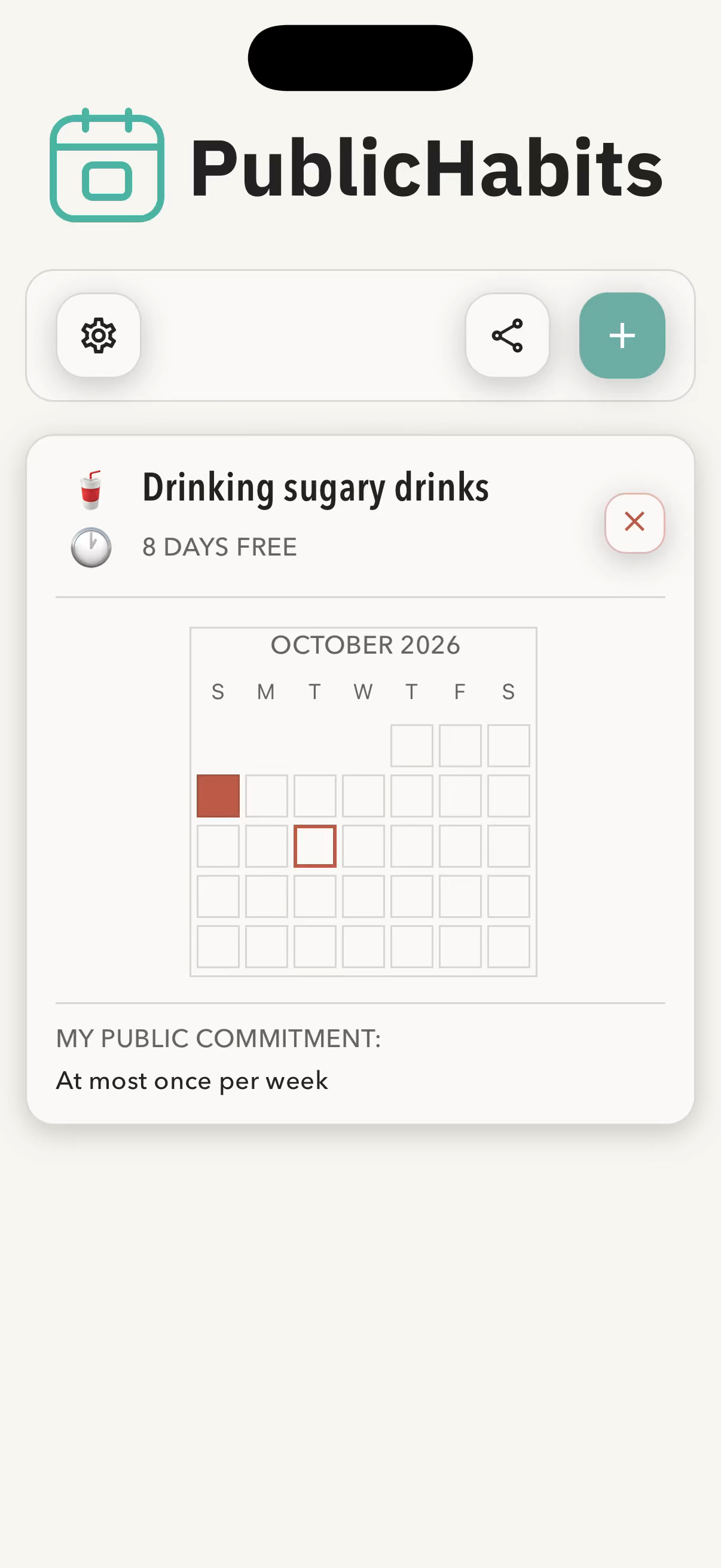
PublicHabits vs. private habit trackers like Streaks
Streaks, Loop Habit Tracker, and HabitKit are private trackers, and that’s their weakness. On the day after you miss, nothing happens. Nobody sees the broken streak, and nobody notices when you stop opening the app. That’s how a strong start turns into an abandoned app.
PublicHabits keeps the same simple loop of a daily check-in, a streak, and a calendar, and adds the one thing a private tracker can’t: the chance that someone who knows you is looking.
Choose PublicHabits if you’ve tried private trackers and found them easy to ignore.
PublicHabits vs. gamified habit trackers like Habitica
Habitica turns your habits into a role-playing game, with gold, gear, and a party to quest with. The problem is that the stakes are fictional. Once the novelty fades, losing health points on the day after a miss stops meaning much.
PublicHabits has no points, avatars, or levels. The stakes are in real life: the people you shared your link with can see whether you showed up, and that doesn’t wear off when the novelty does.
Choose PublicHabits if you want a plain record of what you actually did, with nothing to unlock and nothing to get bored of.
PublicHabits vs. commitment contracts like stickK and Beeminder
stickK and Beeminder put real money on the line: you pledge an amount, and you pay if you don’t follow through. stickK also lets you name a referee to confirm your progress.
The catch is what you sign up for. You agree in advance to be fined, decide how much failure should cost, and with stickK, recruit someone to referee you. That’s a big ask, and it turns a bad week into a bill.
PublicHabits gives you real stakes without the penalty. Nobody fines you, and there’s no referee to recruit. The stake is a visible record, and the cost of a miss is that someone might see it.
Choose PublicHabits if you want real stakes with people whose opinion of you matters.
PublicHabits vs. social habit apps like HabitShare
Social habit apps like HabitShare let you share habits with friends who also use the app, and some let you choose which habits each friend can see.
The weak point is the word “join.” Your audience is limited to people willing to install the same habit app, and it shrinks as they stop opening it. On the day after you miss, the friend who would have noticed may not have opened the app in weeks.
PublicHabits uses one link that opens in any web browser, with no account or download. You can share it with people who would never install a habit app: a partner, a parent, a coworker, a group chat, or your audience on social media.
Choose PublicHabits if the people you want watching, from your partner to your social media audience, to go beyond just those who would install a habit app.
PublicHabits vs. a coach or accountability partner
A coach or accountability partner gives you a real person who checks in. But a coach costs money, and a partner depends on someone else staying as committed as you are. When the payments stop or your partner gets busy, the accountability stops too.
PublicHabits keeps the part that works (people who can see whether you showed up) without anyone having to schedule a check-in. Alternatives to a private coach or accountability partner covers this in detail.
What’s in PublicHabits, and what’s left out
| Feature | PublicHabits | Details |
|---|---|---|
| Shareable public page | One link per account. Off until you turn it on. | |
| Viewing without an account | Your page opens in any web browser. | |
| Streak counter for good habits | Counts consecutive days logged. Past days stay on your page after a miss. | |
| Days free for bad habits | Shows days free since your last slip-up. | |
| Written public commitment | Required for every habit. Changes get a dated note viewers can see. | |
| Reminders | Optional reminders on iOS and Android if today’s habits aren’t all logged. | |
| In-game points, levels, or rewards | The stakes are real on PublicHabits, so there are no in-game rewards to chase. | |
| Financial penalties | PublicHabits makes your missed days visible, but doesn’t bill you for them. | |
| Coaching or accountability partners | You don’t have to schedule a check-in or pay for one-on-one coaching. |
Who PublicHabits is for
PublicHabits is built for someone who has tried habit trackers, started strong, and quietly stopped. You already know what you want to change. What you’ve been missing is a reason to show up on the days you don’t feel like it. That’s what PublicHabits gives you.
PublicHabits is for you if you:
- Have a habit you keep restarting
- Have abandoned at least one habit tracker
- Want to be seen when you build good habits and break bad ones
- Want to share with others without having them install an app
Frequently asked questions
How is PublicHabits different from a typical habit tracker?
It does everything a basic habit tracker does: one-tap check-ins, streaks, and a calendar. The difference is what happens when you miss a day. PublicHabits puts your record on a page people who know you can check, so a skipped day isn’t something only you know about. That’s why it’s built as a behavior change app, not just a tracker.
Is PublicHabits better than a private tracker like Streaks?
Try PublicHabits if you’ve tried habit trackers before, but haven’t seen lasting change. When you miss a day in Streaks, Loop, or HabitKit, or quit entirely, nobody notices. PublicHabits keeps the same simple check-in and adds a page people who know you can see, so tomorrow’s check-in still matters after today’s was skipped.
Is PublicHabits better than Habitica?
If you want stakes that don’t wear off, yes. Habitica motivates you with gold, gear, and in-game penalties, which work only as long as the game stays fun. PublicHabits has no game to get bored of: the stakes are people who know you seeing whether you showed up.
Does PublicHabits charge me money if I miss a day?
No. Unlike commitment-contract apps such as stickK and Beeminder, PublicHabits never charges you for missing a day. Your streak starts over, the day stays blank on your page, and every day you’ve already logged stays visible. The stake is being seen, not paying money.
Do people need the app to see my habits?
No. Your page opens in any web browser, with no account or download. That’s the biggest difference from social habit apps like HabitShare, where friends have to join the same app before they can see anything.